Our take
Chateau Ste Michelle Indian Wells Red Blend Washington Red Wine
- Style
- Red wine
- Size
- 750 ml
- Region
- Washington State
- Shelf barcode
- 0088586004971
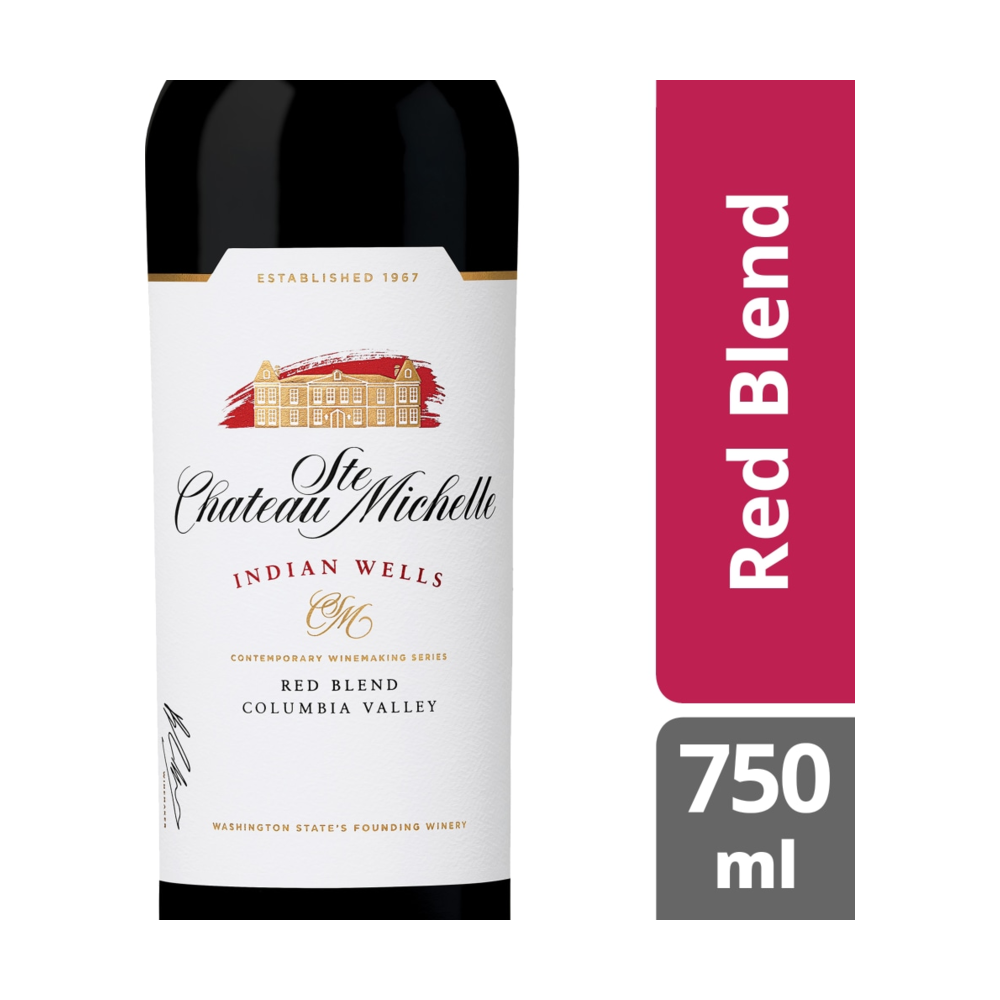
Our take
What we make of this bottle
This is a Washington red blend, from a state whose vineyards mostly lie inland, on the dry side of the Cascade Range. Across our September 2026 checks it was listed between $17.99 and $25.99.
Our Washington research explains why that inland spot matters. The Cascade Range keeps most of the Pacific's rain on its western side, so the vineyards to the east ripen through warm, dry days and cool nights, with real exposure to winter frost. A Washington name like this one can cover a blend drawn from across the state rather than one patch of vineyard, and while the label calls it a red blend, we cannot confirm exactly which grapes go into it.
On the store listing, the average is 5 out of five, from 3 ratings. That is a small group of shoppers, so it reads as a first impression rather than a settled verdict.
The winery fills in the longer story. Chateau Ste. Michelle says it was established in 1967 as what it calls Washington's first premium winery, based in Woodinville. It also says the Wyckoff family bought the winery in 2025, returning it to local ownership for the first time in fifty years.
Chateau Ste. Michelle's own shop currently lists three wines under the Indian Wells name, a Merlot, a Cabernet Sauvignon and a Chardonnay, all sourced from Columbia Valley, Washington; a standalone Indian Wells Red Blend does not appear among them, so we cannot confirm this bottle's exact grape composition against a current producer listing. What the producer's site does confirm is the tier's price point: the individual Cabernet Sauvignon sells for $20 on the producer's own site, and a 12-bottle mixed case across the tier is priced to work out to that same $20 average per bottle.
Our call: reasonable for a shopper who trusts the Indian Wells tier on the producer's account of its Columbia Valley sourcing and its roughly twenty-dollar tier pricing. Pass if you want this exact bottle on the maker's books; the producer's current lineup shows no standalone Indian Wells Red Blend, so the record leans on the tier rather than the wine, and three perfect scores are a start.
The Grocery Store Wine Desk · written Sep 16, 2026 from our research file for this wine. Numbers reflect our latest checks.
More from the desk.
Related bottles with a written overview and a public evidence file.
Columbia Crest
Read our take →Chateau Ste Michelle
Chateau Ste. Michelle Cabernet Sauvignon Washington Red Wine
Read our take →Joel Gott
Joel Gott Washington Red Wine 750 ml
Read our take →H3
H3 Cabernet Sauvignon Washington Red Wine
Read our take →Columbia Crest
Columbia Crest Grand Estates Red Blend Washington Red Wine
Read our take →14 Hands
14 Hands Merlot Washington Red Wine
Read our take →The prices we checked
Dated store checks, not a promise about your store.
- Kroger, Atlanta suburbs, GA$22.99
- Fred Meyer, Portland, OR$25.99
- King Soopers, Colorado Springs, CO$17.99
- QFC, Tacoma, WA$22.99
The regular price can vary by store and date.
From the producer
Washington's founding winery
Chateau Ste. Michelle says it was established in 1967 as Washington state's first premium winery, built in Woodinville. The winery's own site also says the Wyckoff family bought Chateau Ste. Michelle in 2025, returning it to local ownership for the first time in 50 years.
Research status
What we are still checking
Our overview above draws on the dated store feed, shopper ratings, our region and grape research, and any sourced producer facts. We are still working to confirm the current release, the full producer record, and the bottle itself, and we update this page as we learn more.
Getting to know Washington State.
A Washington label can point to a large state blend or to a narrower AVA. Most vineyards are east of the Cascade Range, but the exact AVA still matters because elevation, wind, rain and frost exposure change across the state.
What the name means
Washington is a state origin, not one American Viticultural Area. Its wine regions include 21 federally recognized AVAs, some shared with Oregon.
How grapes grow here
The Cascade Range blocks much of the Pacific rain from eastern Washington. That creates generally dry growing conditions with warm summer days, cool nights and winter frost risk, while western sites have stronger marine influence.
What lies under the vines
Flood deposits, windblown silt, sand, gravel and volcanic material occur across Washington wine country. A state name alone does not identify one soil or vineyard setting.
How large the region is
- Recognized AVAs
- 21 wine-growing areas are listed by the Washington State Wine Commission.
- Label resolution
- Washington State is broader than an AVA, so the bottle or producer must establish a more specific place.
Places within the region
- Columbia Valley
- A very large AVA that contains many of Washington's smaller wine regions and crosses into Oregon.
- Yakima Valley and Walla Walla Valley
- Two established AVAs within the broader eastern Washington landscape, each with its own boundaries and local conditions.
Where this information comes from
- Store listing
- Price, package, product identifier, and shopper rating. Checked Aug 10, 2026.
- Barcode
- The shelf barcode shown here is computed from the store product identifier. It has not been checked against a bottle.
- Method
- Every price, rating and fact here is a dated observation. How we check.