Our take
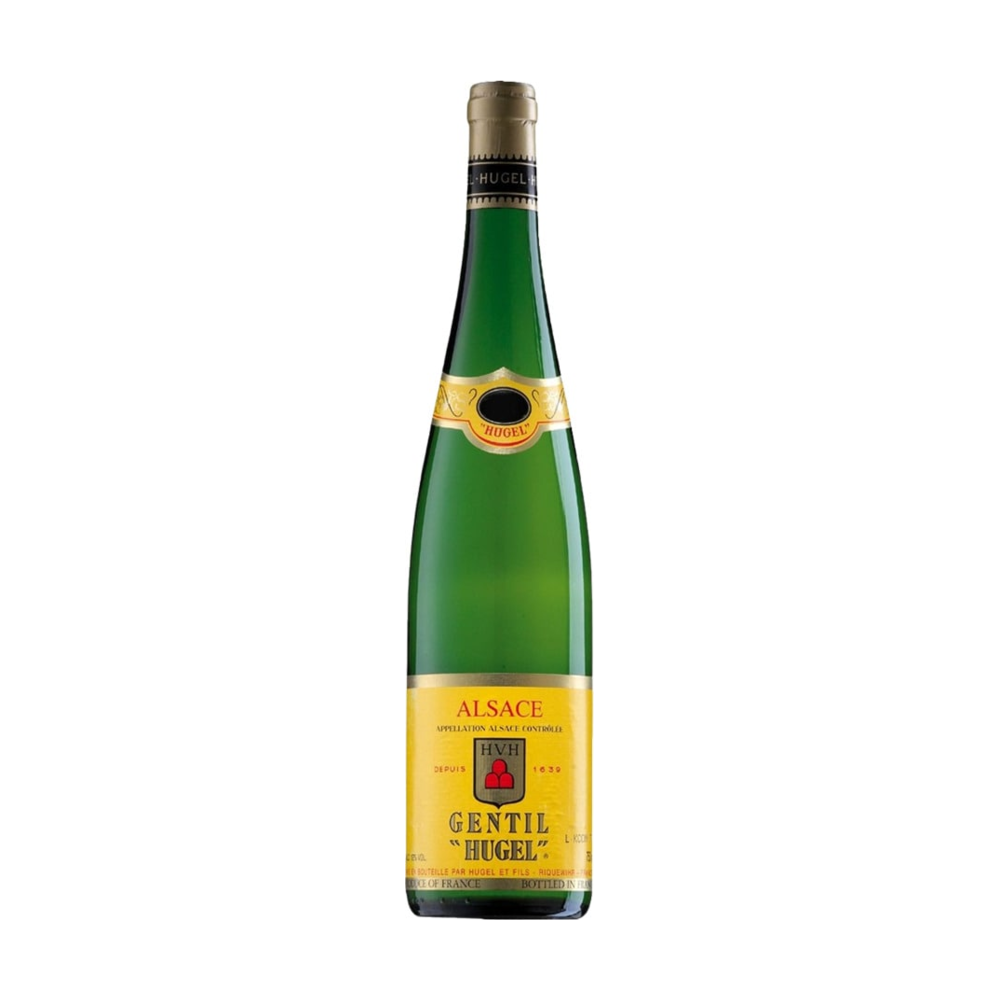
Hugel Gentil Alsace France White Wine
- Style
- White wine
- Size
- 750 ml
- Region
- France
- Shelf barcode
- 0089744382702
Our take
What we make of this bottle
So the name gives Alsace, but the origin we can confirm stops at the country: France. French vineyards sit in settings as different as Atlantic and Mediterranean, so the word France points to a country rather than to one kind of weather or one grape. The name also carries the word Gentil, and though our checks in September 2026 put the price between $16.99 and $29.99 across the seven stores we looked at, our record did not at first break out the grapes behind the wine; the producer's own blend sheet, below, closes that gap.
Hugel's own shop describes this wine's place in the range plainly: Gentil is, in the producer's words, “the only wine in our production that is not a single varietal”, and its own account calls it the house's entry point, “the perfect introduction to Famille Hugel wines”. For the current 2024 vintage, the producer's blend breakdown reads Gewurztraminer 30 percent, Pinot Gris 24 percent, Riesling 19 percent, Sylvaner 18 percent, Pinot Blanc 6 percent and Muscat 3 percent, a mix the producer says balances power with elegance and freshness with generosity, though the exact vintage on this store's shelf is not confirmed against that 2024 listing.
The producer adds its own history. Famille Hugel says the estate was founded in 1639 in Riquewihr, in Alsace, and is still fully family owned, now in the hands of the 12th generation. That is the house describing itself, not a promise about what is in this bottle. We do not have a shopper rating for this bottle, so there is no score to weigh here. The history is on record and the blend is now on record too, by the producer's own 2024 listing; the exact place within Alsace for this specific bottling is what the record still leaves open.
On the estate itself, Famille Hugel says it owns 30 hectares of vines in Riquewihr, most of it classified Grand Cru, and buys grapes grown by contracted partners on nearly 100 more hectares; the estate's own vines average roughly 35 years old, and its cellars hold a barrel called the S. Caterine, dated to 1715 and recognized by the Guinness Book of Records as the oldest barrel still in use. The family also belongs to Primum Familiae Vini, which the producer describes as an association of the world's most prestigious wine families.
Our call: buy it if four centuries of one family telling its own story is enough for you; Famille Hugel's own account, an estate founded in 1639 on largely Grand Cru ground in Riquewihr, plus a full blend breakdown for Gentil's current vintage, is more documentation than most bottles at this price disclose. Pass if you want a shopper record or a confirmed vintage match to lean on instead; no rating has reached us, and the blend we found is only confirmed for the producer's 2024 listing, not necessarily the vintage on this store's shelf.
The Grocery Store Wine Desk · written Sep 16, 2026 from our research file for this wine. Numbers reflect our latest checks.
More from the desk.
Related bottles with a written overview and a public evidence file.
William Fevre Chablis
Read our take →Gerard Bertrand
Gerard Bertrand La Grande Bleue Blend France White Wine
Read our take →Chevalier du Grand Robert
Chevalier du Grand Robert Loire Sauvignon Blanc French White Wine
Read our take →Auvigue
Auvigue Pouilly-Fuirsse Chardonnay French White Wine
Read our take →Domaine Chanson
Domaine Chanson Chardonnay Rully Blanc French White Wine
Read our take →Gerard Bertrand
Gerard Bertrand Orange Gold France White Wine
Read our take →The prices we checked
Dated store checks, not a promise about your store.
- Kroger, Atlanta suburbs, GA$18.49
- Kroger, Cincinnati, OH$22.99
- Fred Meyer, Portland, OR$22.99
- King Soopers, Colorado Springs, CO$16.99
- Kroger, Knoxville, TN$17.99
- Kroger, Richmond, VA$23.99
- QFC, Tacoma, WA$29.99
The regular price can vary by store and date.
From the producer
Family estate since 1639
Famille Hugel says it was founded in 1639 in Riquewihr, Alsace, and remains 100 percent family owned and run today by the 12th generation.
Research status
What we are still checking
Our overview above draws on the dated store feed, shopper ratings, our region and grape research, and any sourced producer facts. We are still working to confirm the current release, the full producer record, and the bottle itself, and we update this page as we learn more.
Getting to know France.
A wine identified only as French can come from many climates, grapes and production rules. The country tells us where it comes from, while an appellation or producer record is needed for a closer account of place.
What the name means
France is a country of origin, not one wine appellation. French labels may also carry a protected AOP or IGP name with a much narrower legal boundary.
How grapes grow here
French vineyards span Atlantic, continental, Mediterranean and mountain-influenced settings. There is no single French growing season that can describe every bottle.
What lies under the vines
France's official wine areas cross river gravels, limestone and clay, granite, schist, sand and volcanic ground. The country name by itself does not establish one soil profile.
How large the region is
- Geographic reach
- Official wine indications are distributed across the country rather than one continuous vineyard zone.
- Record scope
- This guide explains a country mapping only. It does not replace a specific regional record.
Places within the region
- Protected origins
- INAO maps separate AOP and IGP wine areas, including Bordeaux, Champagne, the Rhône Valley, Provence and many others.
- What to check next
- Look for a named AOP, IGP, region or producer source before assigning local climate or soil detail.
Where this information comes from
- Store listing
- Price, package, product identifier. Checked Aug 10, 2026.
- Barcode
- The shelf barcode shown here is computed from the store product identifier. It has not been checked against a bottle.
- Method
- Every price, rating and fact here is a dated observation. How we check.